


Mengelola keuangan rumah tangga memang bukan pekerjaan remeh, apalagi jika penghasilan suami - bisa jadi ditambah penghasilan istri - masih tergolong pas pas-an. Dalam hal ini perlu jurus jitu agar ibu rumah tangga tidak terus menerus 'menjerit' menjelang akhir bulan. Salah satu jurus itu adalah dengan menyeimbangkan pengeluaran dengan pemasukan, menurut perencana keuangan keluarga Ahmad Gozali. Disini yang perlu diperhatikan adalah menyeimbangkan antara keinginan dengan pemasukan. Jadi keinginan membeli sesuatu harus melihat dahulu kemampuan. Jadi jika menginginkan sesuatu, lihat dulu apakah pemasukan cukup atau lebih. Jika tidak cukup, lebih baik jangan dipaksakan. Yang terjadi di banyak rumah tangga selama ini adalah lebih banyak pengeluaran ketimbang pemasukan. Mestinya setiap pengeluaran rumah tangga harus ada daftar prioritas sehingga tidak sembarangan. Daftar prioritas pengeluaran rumah tangga:
1. Zakat sebesar 2,5%.
2. Membayar cicilan hutang, jumlahnya jangan lebih dari 30%.
3. Menabung dan membayar asuransi ( 10 - 20% ).
4. Membiayai kebutuhan sehari hari ( 40 - 50% ).
Jurus lain yang ditawarkan Ahmad Gozali untuk mengatur keuangan rumah tangga adalah mengalokasikan surplus dengan optimal. Maksudnya, seseorang harus menginvestasikan harta yang dimilikinya agar tidak mandek, tetapi terus berkembang sehingga semakin banyak. Hal yang keliru adalah menginvestasikan surplus keuangan dengan membeli barang barang yang konsumtif. Jurus berikutnya adalah mengatasi defisit dengan bijak. Maksudnya jika suatu kali terjadi defisit, hindari berhutang dengan pembayaran yang berkepanjangan. Kalaupun suatu kali terjadi pengeluaran tidak rutin dan mendesak, maka solusinya harus ada uang cadangan, semisal berupa tabungan.
Untuk menyiasati harga harga barang kebutuhan rumah tangga yang terus meroket, solusinya adalah dengan berhemat dan kalau bisa mencari penghasilan tambahan. Jika belum cukup juga dengan penghasilan tambahan, itu artinya anda seorang pemboros. Solusinya, kurangi penghasilan, tetapi itu bukan berarti anda minta pengurangan gaji, tetapi maksudnya membatasi membawa uang tunai, lebih baik amankan uang anda di bank atau membeli emas sebagai investasi.
Kiat lain adalah mengelola dan melindungi aset dengan baik. Islam mengajarkan untuk memisahkan harta yang dibawa istri, warisan orang tua istri dengan harta yang dibawa suami. Hal ini berkaitan dengan hak waris dikemudian hari.
Sabtu, 07 Januari 2012
JURUS JITU MENGELOLA KEUANGAN RUMAH TANGGA

TIPS MENGELOLA KEUANGAN KELUARGA
Sebagai pasangan baru Anda dan pasangan pasti masih harus banyak melakukan penyesuaian termasuk dalam mengelola keuangan keluarga. Uang memang harus dikelola dengan baik, karena jika tidak nantinya bisa menimbulkan masalah dalam keluarga Anda. Bahkan menurut Dr. Judy Kuriansky, penulis The Complete Idiot’s Guide to a Healthy Relationship, uang adalah salah satu dari tiga hal yang merupakan sumber masalah dalam sebuah keluarga. Dua sumber lainnya adalah seks dan pengasuhan anak. Dr. Judy memberikan tips bagaimana mengelola keuangan keluarga. Tips ini bisa Anda intip, tentunya untuk menghindari masalah keuangan yang bisa muncul kemudian hari.
1. Uang untuk merayakan hari besar. Perayaan hari besar baik hari raya keagamaan, ulang tahun atau hari istimewa lainnya pasti membutuhkan sejumlah uang. Anda pasangan harus sepakat seberapa besar uang yang dialokasikan untuk merayakannya. Tentunya dengan mempertimbangkan keperluan pokok, sehingga uang yang dikeluarkan untuk hari raya tidak menggangu anggaran pokok lain.
2. Pengangguran, atau pemberhentian sementara. Status penggangguran atau diberhentikan sementara secara otomatis menimbulkan masalah keuangan. Selain itu, tentu saja berpengaruh pada menurunnya rasa percaya diri dan menimbulkan emosi mudah terpancing. Jika hal tersebut melanda Anda atau pasangan sebaiknya diskusikan langkah-langkah penghematan yang bisa diambil. Hal itu untuk menghindari terjadinya pertengkaran yang di picu perbedaan pendapat dalam pengeluaran.
3. Promosi, dan kenaikan gaji. “Promosi dan kenaikan gaji pun bisa menjadi sumber masalah dalam keluarga,” kata Dr Judy. Anda dan pasangan harus membuat rencana keuangan agar uang yang kelebihan uang yang masuk bisa digunakan dengan baik dan tidak terbuang percuma tanpa bekas.
4. Kebutuhan anak-anak, hiburan, pendidikan dan rekreasi. Kebutuhan tersebut adalah tentunya harus dipenuhi, dan jangan mengabaikan kebutuhan rekreasi dan hiburan, Karena hal itu bisa mendekatkan Anda dan anak-anak. Untuk itu, buatlah anggaran untuk rekreasi dan liburan bersama keluarga. Ajarkan juga anak-anak untuk mengelola uang jajan mereka.
5. Rumah, mobil, apartemen. Ketika membeli rumah, mobil atau barang mewah lainnya sebaiknya pikirkan tidak hanya masalah materi tetapi juga emosi. Pengeluaran yang besar tentu berimplikasi pada banyak hal termasuk pengeluaran Anda selanjutnya. Untuk itu, jangan membuat keputusan yang hanya memikirkan diri sendiri saja, pertimbangkan juga kepentingan pasangan.
Kamis, 05 Januari 2012
4 Mistakes in Setting Financial
But in general, each person may experience financial problems due to errors in management. Even so, it's never too late anyway, if you want to fix it. Here are basic things that cause the occurrence of errors in managing finances:
1. Feeling not have time to manage it
Many of us who often complain about not having time. But from 24 hours a day do you have, did you really do not have the time? Of course, you actually have the time: you just do not give priority to schedule financial management. When coming home from your office already feel so tired, try to schedule a money management is on Saturday morning. From paying the bills, noting the various expenses for a week, or learn the investment programs offered by the bank. Always remember, the more you delay this work, the harder you make a habit of keeping your finances.
2. Not doing financial planning
Said the financial plan, or a checkbook, often make people quit. So important yes, record every dime you spend, or restrict any expenses even though it was only bought coffee and a donut? Maybe it does not need sejelimet. But there is a more practical way to track where your money goes. One of them, using an envelope for a week or a month, like when you get a weekly allowance from your parents.
"The way it's still worth it to find out how much you spend in a week or a month, and this could be applied to the whole family, from you, your husband, children," said Peter Sander, author of The Pocket Idiot's Guide to Living on a Budget.
It's up to how you use the money, whether to buy credits, lunch at the office or outside the office, or just for transportation. Then, prepare well for snacks on the outer envelope of these requirements, such as buying coffee, snacks, magazines, or whatever. Condition, limit your spending as much money contained in the envelope. Do not add money into the envelope, as if the envelope is a phone that pulse to be recharged.
3. -Too much or too little-debt
Who says the debt is always a negative result? Debt will not destroy your life if you can use it for your next life. With debt, you can go back to school, which then can buy your rented apartment (so that you can use the lease payments to pay the mortgage), and even can provide venture capital for you. Fear of debt can sometimes make you lose the opportunity, but too much debt, especially if the debt exceeds your ability to pay the mortgage, could lead to chaos in your financial condition.
4. Depending on the insurance
You realize that the current Indonesian people have started to "insurance minded". Glad you had bought a life insurance product since 10 years ago, which still must you pay premiums for 20 years. You do not want to buy an insurance product or other investment, because it feels your responsibility to provide a form of security to your life has been done. Unfortunately, you forgot to take into consideration, inflation may cause the payment of insurance benefits next 20 years might not be too large value. Especially if you choose insurance products to the value of the lowest premiums.
Definition / Definition of Financial Management, Duty Manager Finance and Corporate Objectives
Financial management is an activity of planning, budgeting, inspection, management, control, retrieval and storage of funds owned by an organization or company.
Brief Description of Each Function Financial Management:
1. Financial Planning
Make a plan and expenditure income and other activities for a certain period.
2. Financial budgeting
Follow-up of financial planning by making detailed expenses and income.
3. Financial Management
Using company funds to maximize the funds available with a variety of ways.
4. Search Finance
Finding and exploiting existing funding sources for operational activities of the company.
5. storage Finance
Companies to raise funds and save money safely.
6. Financial control
Evaluation and improvement of financial and financial system in company.
7. audit
Conduct internal audits of the financial companies that exist to prevent irregularities.
B. Duty Financial Management
Basic tasks are performed by a financial manager in general are:
1. Getting Funds Company
2. Using Company Funds
3. Dividing Profit / Profit Company
C. Objectives of Financial Management
The goal with the finance manager for to manage company funds on a company in general is to maximize firm value. Thus if one day the company is sold then the price can be set as high as possible.
Basics of Family Financial Management Professional (1)
Understanding Majamen Cashflow
Cash flow or cash flow is the flow of money that flows from us to get the money, keep it, develop it, and remove it by regularly, wisdom and discipline.
Knowledge of cash flow must be noted that our family finances would not be chaotic and monitored. There is an interesting phrase "do not care about your finances is a deficit, which is important you know where the flow of money." Let's discuss the cash flow diagram as follows:
Revenue
Revenue (income) is an activity that aims to put money / possessions. Usually the revenue can be obtained from the two activities, namely salaries and Investment.
Salaries obtained from our status as an employee / employees / professionals / consultants. In a family wage can be obtained by a husband and wife working.
Investment results obtained from our activities in developing the money / wealth in various ways. There are several ways you can do to invest the deposits, Property, Stocks, Business Results, Mutual Funds, Bonds, etc..
Well, all our income is usually stored in the form of cash or in bank / ATM.
Expenditure
Expenditures means all activities that result in reduced our money. From the diagram we can see the need for spending a lot of our family. So if not set properly then would make the family finances into chaos when it is chronic and can lead to the brink of bankruptcy.
In general, a family has some expenses such as Household Spending, Debt repayments, insurance premiums, Domestic Help, Children's Needs, Transportation, Zakat / Taxation, Entertainment / Recreation, Social Events, Fashion, and so on.
When we look over this, common mistakes made by most families are just struggling on income derived from salary continually drained to cover expenses. angat few of our families who began investing activities as a source of family income. And if we diligently invest, then the result of that investment has actually been able to cover all kinds of our expenses, even far greater than the salary that we receive during this.
The above description is an ideal condition that should be achieved by each family. If your family is still entirely dependent on the flow of income from salaries each month, then it's time for a little money aside so you can create a new revenue stream derived from the investment.
Senin, 02 Januari 2012
THE FINANCE CYCLE

When the government prints new banknotes and coins, the money is used to replace the old money instead of creating new money. Number of circulation of money is constantly changing. That is the demand and supply of money changing. Increased demand for money thanks to the high place of birth ATM.
A. Forms of Exchange Accompanied by Meaning Definition / Definition
1. Fiat Money / Money Tokens
Fiat money is money that the nominal value is much higher than the material for the money. The money will be valuable because the government and the community have agreed to accept the money with a certain value. Example: Rp. 50.000, - cost of production may not Sampa Rp. Perlembarnya 20,000, but these bills have the same value with gold valued at Rp. 50.000, -.
2. Money Commodities
Commodity money is money which the material manufacturer / commodity materials with nominal value of money. Example: In the past the bronze, silver and gold used as a medium of exchange whose value economic transactions differ from each other where the gold is higher than silver and silver worth more than the bronze.
3. Money Almost Perfect Liquid
Money is a nearly perfect liquid assets that can be used as money but not all economic actors willing to accept as payment because it must first be exchanged with liquid money (fiat and commodity money) if you want to use on all economic actors. Examples of checks that can be used in some places as a means of payment that can be withdrawn into real money.
B. Tiger and Money Types Accompanied by Meaning Definition / The sense
1. Currency
Currency is the money used as a means of legitimate transactions and shall be admitted to the whole society on the economy. Generally in the form of currency banknotes and coins in Indonesia made by Bank Indonesia as the central bank is given the sole right to print the / rights oktroi. The money is protected by the Act in which the perpetrator counterfeiting punishable by fines and prison sentences. Examples of such currency coins Rp. 100, - USD banknotes. 1.000, - and so forth.
2. Money Giral
Demand deposits is a bill in the commercial banks that can be used as a means of payment and transactions are legitimate and masyarakt not obliged to accept payment. Demand deposits can be practically easy, safe and practical because the transactions in which one does not need to calculate and carry lots of cash, if lost or fall into the hands of evil people can be immediately blocked and easy of use. Examples of demand deposits which are like checks, demand deposits, telegraphic transfers, and others.
3. Quasi money
Quasi money is valuable Surata or certificate that can be used as legal tender. Examples of quasi money is stocks, bonds, and others.
The Types Of Money
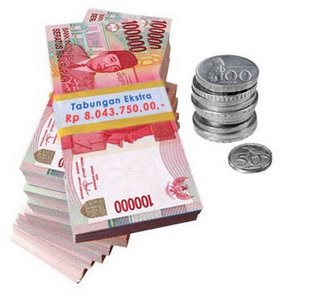
Money is a medium of exchange and legal tender. in previous years, payments made by way of barter, the goods exchanged for goods directly.
kind of money circulating in the community can be grouped into two, namely currency and demand deposits.
Currency
Consists of currency banknotes and coins. Currency is a means to pay a legitimate and must be accepted by the community in conducting transactions daily.
According to Central Bank Law No. 13 of 1968 article 26 paragraph 1, Bank Indonesia has the sole right to issue coins and paper. Sole right to issue money held by the Bank Indonesia is called oktroi rights.
Types of Money According to Institution that issued
According to the Basic Law of Bank Indonesia. 11/1953, there are two types of currency, namely the state money and bank money.
State money is money spent by the government, made of paper that has the characteristics:
• Issued by the government
• Guaranteed by the laws
• bearing the name of the issuing country
• signed by the finance minister
However, since the enactment of Law no. 13/1968, the money the state stopped its circulation and replaced by the Money Bank.
Bank money is money issued by the Central Bank in the form of coins and banknotes, as follows Characteristics.
• Issued by the Central Bank
• Secured by gold or foreign currencies are recorded at the central bank
• The central bank bearing the name of the country concerned (in Indonesia: Bank Indonesia)
• Signed by the governor of the central bank.
Types of Currency Composition According to author
A. Coin
The coins are usually made of gold or silver because gold and silver meets the requirements of an efficient money. Because the price of gold and silver which tends to be high and stable, gold and silver are easily recognized and accepted people. In addition, gold and silver is not easily destroyed. Gold and silver are also easily be divided into smaller units. In the current era, the coin is not judged by the weight of the gold, but of their nominal value. Face value is the statement that a certain number of gold by weight contained in it.
The coin has three kinds of values.
Intrinsic value is the value of materials to make the currency, for example how the value of gold and silver used for coinage. Historically, gold and silver money once used as money. There are several reasons why gold and silver used as money among other ingredients:
• Durable and not easily broken (U.S. $ 100.00), or five hundred dollars (U.S. $ 500.00).
Exchange Rate, exchange rate is the ability of money to be exchanged with a good (the purchasing power of money). For example money USD. 500.00 can only be exchanged for a candy bar, while the Rp. 10000.00 may be exchanged with a bowl of meatballs).
B. Paper Money
Paper money is money made of paper with pictures and a certain stamp and is the legal tender. According to the Law no. 23 of 1999 concerning Bank Indonesia, which is the paper money is money in the form of sheets made of paper or other materials (like paper).
Paper money has value because of nominal. Therefore, the bill has only two kinds of value, the nominal value and exchange value. There are 2 (two) kinds of paper money:
• State Banknotes (already circulated no more), ie paper money issued by governments and legal tender with a limited amount of finance ministers and signed.
• Banknotes Bank, the money spent by the central bank,
Some advantages of using a medium of exchange (money) from the paper include:
• Saving on the use of precious metals
• The cost of manufacturing is relatively inexpensive compared with the cost of coinage.
• circulation of paper money is elastic (because it is easily printed and copied) so easily diseusaikan with the need for money
• Facilitates delivery of large amounts of
Money Giral
Demand deposits created by the increasingly urgent needs of the community that there is a medium of exchange that is easier, practical and safe. In Indonesia, the bank is entitled to create demand deposits of commercial banks other than Bank Indonesia. According to Law no. 7 on Banking in 1992, the definition of demand deposits is a bill that is in commercial banks, which can be used at any time as a means of payment. Form of demand deposits may be checks, demand deposits, or transfer telegrafic.
Demand deposits is not a legal tender. That is, people may refuse paid by demand deposits.
The occurrence of demand deposits
Demand deposits can occur in the following way.
• Deposit cash to the bank and recorded in a checking account on behalf of the depositor, depositor receives a check book and giro books bilyet. That money can be taken at any time or depositor receives payment from the debtor through bank debt. Acceptance by the bank's receivables were recorded in newspaper accounts of people concerned. How the above is called a primary deposit.
• Due to securities transactions. Demand deposits can be created by selling securities to banks, then booked the sale of bank securities such as the deposit of the selling. This method is called the derivative deposit
• Getting credit from banks that are recorded in newspaper accounts and can be retrieved at any time. This method is called with the loan deposit.
Payment by demand deposits can be made by check, giro bilyet, and telegraphic transfer [telegraphic transfer]. The advantage of using demand deposits
The advantage of using demand deposits as follows.
• Facilitate the payment because they do not need to count money
• Tools of payment are acceptable for an unlimited number, its value as required (written by the owner of the check / giro)
• It's safer because the risk of money lost is smaller and if lost can be transparently reported to the bank issuing checks / giro blocking manner.
Quasi money
Quasi money are securities that can be used as a means of payment. Usually this consists of quasi money deposits and savings and foreign currency accounts owned by domestic private.
The Types Of Money
kind of money circulating in the community can be grouped into two, namely currency and demand deposits.
Currency
Consists of currency banknotes and coins. Currency is a means to pay a legitimate and must be accepted by the community in conducting transactions daily.
According to Central Bank Law No. 13 of 1968 article 26 paragraph 1, Bank Indonesia has the sole right to issue coins and paper. Sole right to issue money held by the Bank Indonesia is called oktroi rights.
Types of Money According to Institution that issued
According to the Basic Law of Bank Indonesia. 11/1953, there are two types of currency, namely the state money and bank money.
State money is money spent by the government, made of paper that has the characteristics:
• Issued by the government
• Guaranteed by the laws
• bearing the name of the issuing country
• signed by the finance minister
However, since the enactment of Law no. 13/1968, the money the state stopped its circulation and replaced by the Money Bank.
Bank money is money issued by the Central Bank in the form of coins and banknotes, as follows Characteristics.
• Issued by the Central Bank
• Secured by gold or foreign currencies are recorded at the central bank
• The central bank bearing the name of the country concerned (in Indonesia: Bank Indonesia)
• Signed by the governor of the central bank.
Types of Currency Composition According to author
A. Coin
The coins are usually made of gold or silver because gold and silver meets the requirements of an efficient money. Because the price of gold and silver which tends to be high and stable, gold and silver are easily recognized and accepted people. In addition, gold and silver is not easily destroyed. Gold and silver are also easily be divided into smaller units. In the current era, the coin is not judged by the weight of the gold, but of their nominal value. Face value is the statement that a certain number of gold by weight contained in it.
The coin has three kinds of values.
Intrinsic value is the value of materials to make the currency, for example how the value of gold and silver used for coinage. Historically, gold and silver money once used as money. There are several reasons why gold and silver used as money among other ingredients:
• Durable and not easily broken (U.S. $ 100.00), or five hundred dollars (U.S. $ 500.00).
Exchange Rate, exchange rate is the ability of money to be exchanged with a good (the purchasing power of money). For example money USD. 500.00 can only be exchanged for a candy bar, while the Rp. 10000.00 may be exchanged with a bowl of meatballs).
BPaper money
Paper money is money made of paper with pictures and a certain stamp and is the legal tender. According to the Law no. 23 of 1999 concerning Bank Indonesia, which is the paper money is money in the form of sheets made of paper or other materials (like paper).
Paper money has value because of nominal. Therefore, the bill has only two kinds of value, the nominal value and exchange value. There are 2 (two) kinds of paper money:
• State Banknotes (already circulated no more), ie paper money issued by governments and legal tender with a limited amount of finance ministers and signed.
• Banknotes Bank, the money spent by the central bank,
Some advantages of using a medium of exchange (money) from the paper include:
• Saving on the use of precious metals
• The cost of manufacturing is relatively inexpensive compared with the cost of coinage.
• circulation of paper money is elastic (because it is easily printed and copied) so easily diseusaikan with the need for money
• Facilitates delivery of large amounts of
Money Giral
Demand deposits created by the increasingly urgent needs of the community that there is a medium of exchange that is easier, practical and safe. In Indonesia, the bank is entitled to create demand deposits of commercial banks other than Bank Indonesia. According to Law no. 7 on Banking in 1992, the definition of demand deposits is a bill that is in commercial banks, which can be used at any time as a means of payment. Form of demand deposits may be checks, demand deposits, or transfer telegrafic.
Demand deposits is not a legal tender. That is, people may refuse paid by demand deposits.
The occurrence of demand deposits
Demand deposits can occur in the following way.
• Deposit cash to the bank and recorded in a checking account on behalf of the depositor, depositor receives a check book and giro books bilyet. That money can be taken at any time or depositor receives payment from the debtor through bank debt. Acceptance by the bank's receivables were recorded in newspaper accounts of people concerned. How the above is called a primary deposit.
• Due to securities transactions. Demand deposits can be created by selling securities to banks, then booked the sale of bank securities such as the deposit of the selling. This method is called the derivative deposit
• Getting credit from banks that are recorded in newspaper accounts and can be retrieved at any time. This method is called with the loan deposit.
Payment by demand deposits can be made by check, giro bilyet, and telegraphic transfer [telegraphic transfer]. The advantage of using demand deposits
The advantage of using demand deposits as follows.
• Facilitate the payment because they do not need to count money
• Tools of payment are acceptable for an unlimited number, its value as required (written by the owner of the check / giro)
• It's safer because the risk of money lost is smaller and if lost can be transparently reported to the bank issuing checks / giro blocking manner.
Quasi money
Quasi money are securities that can be used as a means of payment. Usually this consists of quasi money deposits and savings accounts as well as domestic private-owned foreign currency.


